Engagement File No. 01: Weldone Events

← The record
Engagement file
No. 01
Client
Weldone Events
Founder
Srikantha
Window
Seventeen days · April 2026
Value
$42,416 contracted
The real game

Nobody buys the wedding. They buy the proof of it.

A couple hiring a planner is paying five figures for something they cannot see, touch, or stand inside until the day itself, when it is far too late to return. So they don't judge the wedding. They judge the evidence of one: how fast you reply, how you present, what the paper says about the studio behind it. Most planners pour everything into the day and treat the proposal as a formality, then lose the booking to someone whose paper simply looked more certain. They win the wedding and never learn they lost the couple. This is the file on Srikantha, and the studio that stopped letting it happen.

The situation

Srikantha's weddings were flawless. Her paper wasn't.

Srikantha runs Weldone Events, a South Asian planning studio in New Jersey, and her weddings are, by any measure, beautiful. The trouble was that no couple ever saw a wedding before they had to commit to one. They saw a proposal, and Srikantha's went out as plain documents, every price built from scratch after midnight, twenty years of vendor knowledge living in her own head. She was asking couples to put five figures behind an attachment that read like an invoice, in an inbox next to competitors whose paper looked exactly the same, and she was losing some of them without ever knowing it happened. That is the studio when this file opens.

The diagnosis

A couple can't inspect the wedding before they buy it, so they judge what they can: the proposal, the reply, the paper. Two things were quietly costing the booking. A five-figure service that arrives as a plain document doesn't read as a bargain, it reads as risk. And every planner in the running sent the same kind of file, so nothing on paper told the couple who to pick. The constraint was never demand or talent. It was that the document carrying the work both undersold it and vanished into the pile.

The decision

The obvious fixes all change who walks in: the feed, the logo, more ads. We changed the last thing a couple reads before they sign instead. The proposal is the cheapest surface in the business to rebuild and the closest one to the money. Then we rebuilt the machine around it, so the fix would hold without us.

The sprint

Seventeen days. Eight proposals. Four signed.

Seventeen days is not much time to rebuild the one document a planning business runs on, let alone prove it pays. We did both. Srikantha's proposal went from a plain attachment to a designed, magazine-grade artifact: a cover that presents the studio, scope written in her own voice, one all-inclusive price instead of a fee maze, a signature page that treats a five-figure decision with the weight it deserves. Then we put it in front of her real, live prospects, the same couples, the same prices, only the paper changed, and watched. By day seventeen, four had signed: $42,416 contracted.

Exhibit A · the ledger
Weldone — The Ledger
ContractEngagementSigned
S. & A.Full planning$7,836.94
A. & A.Full planning$17,500.00
P.Partial planning$5,350.00
D.Full planning$11,729.75
Total contracted4 of 8 proposals$42,416.69

File-verified. Four contracts on disk, names redacted to initials. Average contract $10,604.

Exhibit B · the proposal, before and after

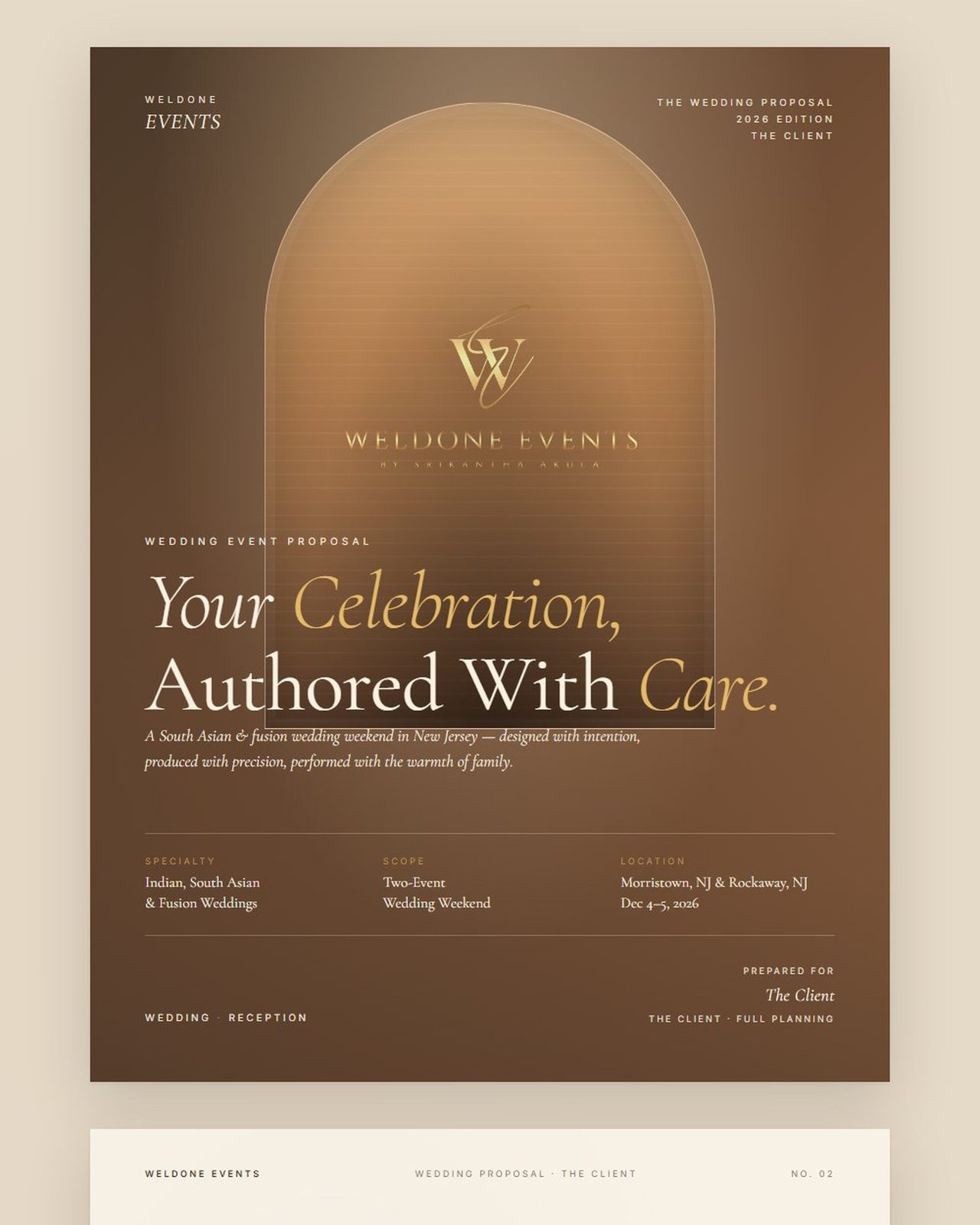
On the left is what Weldone sent couples weighing a five-figure weekend: a plain intake sheet, dates left as TBD, the words “need details from client” running down the page. It asked the couple to do the studio's homework. On the right, the same studio and the same prices, authored as the decision it is.
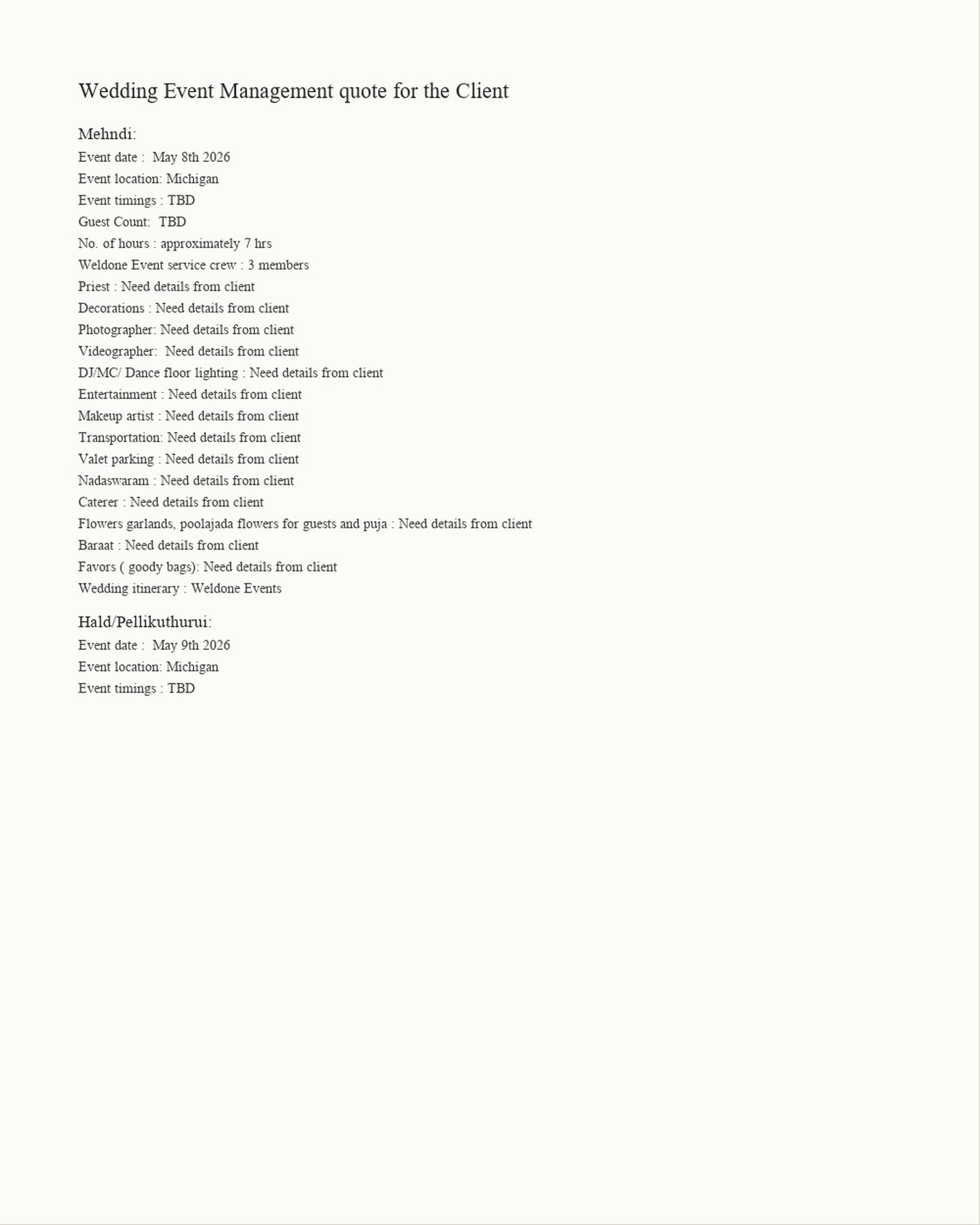
Weldone's original quote: a plain typed checklist with the words need details from client beside most line items and the dates left as TBD.
Before
Weldone's rebuilt proposal cover: the Weldone monogram set in an arch under the headline Your Celebration, Authored With Care, with the specialty, scope, and location named.
After

The work didn't change. The last thing they read did.

What the new proposal is made of

Five sections, each doing one job. Pull one and it stops closing.

  1. i
    The CoverPage 1Names the couple, the date, the studio. They see their own names set with care before they see a price.
  2. ii
    The ScopePage 2The promise sentence, in Weldone's own voice. Before, a bare list of services that could have been any planner.
  3. iii
    The InvestmentPage 4One number on the page. Not “starts at,” not “contact for pricing.” Before, no price at all, just “need details from client.”
  4. iv
    The TimelinePages 5–6Names the cadence and the access commitment, so a couple knows how often they will be held.
  5. v
    The SignaturesPage 7Names the date by which the rate holds. A decision with a deadline, not an open question.
Why it worked

A tier above the pile

Same numbers, same studio. The document now reads a full tier above the ones beside it. When every proposal looks alike, the one built like a five-figure decision becomes the obvious yes, before price is ever discussed.

One price, whole

The old fee maze made couples do math, and math invites doubt. One all-inclusive figure made the decision a yes-or-no, not a negotiation.

The voice held

Every line was written in Weldone's voice canon, so the studio that showed up on paper was the one couples had already met. Nothing felt outsourced, because nothing read outsourced.

The designed-versus-plain teardown of this proposal system, table by table, is in the Journal: the proposal-system case study.

Every planner instinct says itemize: a couple wants the line items, one number hides the work. We disagreed, and so did the close rate, but it was a real argument before it was a result. Collapsing the fee maze into one figure she could stand behind meant trusting that a couple buys a decision, not a spreadsheet, and that was the hardest thing the seventeen days asked of her.
The math

Read the close rate again.

Eight proposals went out in the new format. Four came back signed. A fifty percent close rate, in seventeen days, across a mix of fresh inquiries and couples who had stalled on the old paper. Nothing else moved: same studio, same prices, same season, same market. The one variable was the document, which makes the close rate a clean measurement of what the document was worth.

4 of 8Signed in the sprint 50%Proposals to signatures $10,604Average contract 17 daysFirst format to fourth signature

A fifty percent close rate isn't a marketing number. Marketing changes who walks in. This changed who signs, among the couples already at the table. The last thing they read before deciding had been quietly costing winnable bookings. Once it matched the work, half of them said yes.

And here is what that fortnight bought Srikantha, past the number. Four couples who might have drifted to a studio with glossier paper are hers instead. The after-midnight pricing math is gone. And the document that now goes out the door finally says what she has always known about her own work, before she is ever on the call. The proposal stopped quietly costing her bookings and started winning them.

The machine

Then we rebuilt the machine around it.

The sprint proved the document. But a document doesn't run a business, and we weren't going to hand Srikantha one fixed thing and leave eight others leaking. So the same engagement built her a system: nine pieces, each one because something specific was costing her, an evening, a vendor, the next booking. Every card opens the live artifact, exactly as Weldone runs it today.

In her words
"You completely changed how we do business."
Swetha · lead coordinator, Weldone Events
For your studio

What to take from this, even if we never meet.

I
Your paper is pricing you.

Whatever your work costs, your documents are quoting something, and they're doing it right next to everyone else's. Read your own proposal the way a couple does, side by side with your competitors'. If it reads cheaper than the work, or just reads like all the others, the paper has already decided for you. Build the one that looks like the obvious choice.

II
Sell one decision, not ten.

Every extra line item, option, and fee is another decision you're asking a tired couple to make. Collapse the math. The fewer decisions in the room, the more rooms close.

III
Build it so it works without you.

The sprint made the money, but the database, the canon, and the tiers are what Weldone keeps. If a fix evaporates when the consultant leaves, it was a performance, not a fix.

A booking problem is rarely a talent problem. Weldone's work didn't change in those seventeen days. The documents carrying it did. This is one file from the system: see how every phase runs at The Method.

The model to keep

Two studios competing for the same couple, the same work at the same price. The one whose paper reads a tier higher wins, before price is ever discussed. Call it the tier tax: when every proposal looks alike, the studio with the plainer paper loses the booking and never sees the bill. It is the cheapest tax in the business to stop paying, and most studios never do.

Your file starts with two pages.

The Grid Read is free, by application: what's working, what's leaking, what we would direct first.

Next file: No. 02, Making It Reel, the proving ground.

Apply for the read